

Table Of Contents
- Why Fan Size Matters
- Match the Fan to Ceiling Height
- Choose Features by Room in Fort Mill
- Indoor, Damp, and Wet Ratings
- Airflow, Motors, and Efficiency
- Lighting and Controls
- Installation Checklist Before Buying
- Frequently Asked Questions
- Choose for Comfort, Fit, and Daily Use in Fort Mill
In Fort Mill, South Carolina, a well-chosen ceiling fan can make bedrooms, family rooms, home offices, and covered porches feel more comfortable when the air feels warm and still. The best choice is not simply the fan that matches the paint color. It is the one that fits the room’s dimensions, ceiling height, layout, electrical setup, and everyday use.
Before selecting a fixture, consider whether the mounting location, controls, and support box are ready for the fan you want. Professional ceiling fan installation in Fort Mill, SC can help homeowners replace an outdated fixture, add a fan during a renovation, or create a safer setup where a basic light previously hung.
Why Fan Size Matters in Fort Mill Homes
Blade span affects ceiling fan coverage. A fan too small for a large room may feel stagnant, while one too big can overpower a small space. Measure the room’s length, width, and consider furniture, walls, beams, and openings. Generally, rooms up to 75 sq ft suit 29-36-inch fans; 76-144 sq ft, 36-42 inches; 145-225 sq ft, 44-50 inches; 226-400 sq ft, 50-54 inches; larger rooms may need 60 inches or more or multiple fans. Place fans near the room’s center. For fans with lights, consider both airflow and lighting needs. Coordinating the fixture with lighting installation can be useful when a remodeled kitchen, bonus room, or gathering space needs better coverage without adding clutter to the ceiling.
Match the Fan to Ceiling Height
Ceiling height affects safety, appearance, and airflow. A low-profile or hugger fan is often the practical option for a lower ceiling because it sits close to the mounting surface. Standard-height ceilings usually work with the downrod included by the manufacturer. In rooms with taller or vaulted ceilings, an extended downrod can lower the blades to a more useful position.
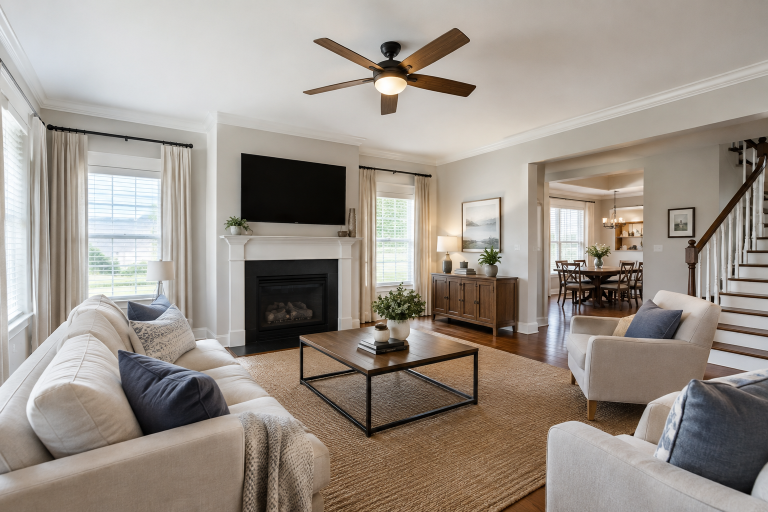
Keep the blades at least 7 feet above the floor and at least 18 inches from walls, according to common installation guidance. A sloped ceiling may also require an angled mounting adapter that is compatible with the chosen fan. Always follow the fan manufacturer’s stated limits for ceiling slope, downrod use, and blade clearance.
Choose Features by Room in Fort Mill
Bedrooms and Home Offices
For sleeping and work spaces, prioritize a quiet motor, several low-speed settings, and simple controls. A dimmable integrated light can reduce the need for another overhead fixture, but consider glare if the fan will be above a desk or computer screen. Compact fans are often easier to place in smaller bedrooms and offices.
Living Rooms, Kitchens, and Dining Areas
Larger living rooms typically benefit from broader blade spans and stronger circulation. Check the relationship between the fan, sofas, tall cabinets, pendant lights, and ceiling beams before buying. In kitchens and dining rooms, choose blades that are easy to wipe clean, and avoid locations that interfere with range hoods, cabinet doors, or hanging fixtures.
Covered Porches and Outdoor Spaces in Fort Mill
Fort Mill’s warm, humid climate means that porches and patios benefit from moisture-resistant ceiling fans. Determine whether the fan will be in a fully enclosed area, a covered screened porch, or an exposed outdoor location. South Carolina’s seasonal weather patterns and porch exposure to humidity and occasional rain affect the moisture rating needed and help protect the fan from premature wear.
Indoor, Damp, and Wet Ratings
- Dry-rated fans are intended for enclosed indoor rooms without regular moisture exposure.
- Damp-rated fans are made for covered areas that may experience humidity or light moisture.
- Wet-rated fans are designed for locations where direct exposure to rain or water is possible.
A dry-rated fan does not automatically belong on a covered porch. Check the product label and installation instructions, then select the rating that matches the actual exposure the location receives. In Fort Mill’s climate, many covered porches require damp-rated fans to withstand humidity and weather conditions.
Airflow, Motors, and Efficiency
Airflow is measured in cubic feet per minute, or CFM. More CFM can be helpful in large rooms but isn’t always better. Consider fan size, speed, noise, and energy use. DC motors are popular for quietness and adjustable speeds, while other fans may use AC motors. Blade pitch, installation, and reversible rotation impact performance. In warm weather, fans create a breeze that boosts comfort and lowers A/C use. In cooler months, reverse settings help circulate air without a strong breeze. The airflow-per-watt efficiency measure provides a useful way to compare airflow with electricity use across qualifying products.
Lighting and Controls
Choose between an integrated LED light, a fan that accepts replaceable bulbs, or a no-light design. Bedrooms often suit warmer, dimmable lighting, while home offices may benefit from brighter task-oriented light. Pull chains are straightforward, wall controls keep operation at a familiar location, and remotes offer convenience from across the room. Smart controls can be helpful, but verify compatibility with the fan, wiring, wireless connection, and any required neutral wire.
Installation Checklist Before Buying
- Measure the room’s length, width, and ceiling height.
- Note beams, recessed lights, smoke alarms, cabinets, and nearby walls.
- Confirm that the ceiling box is listed and installed to support a fan.
- Check whether the switch arrangement can separately control the fan and light.
- Review the fan’s weight, downrod options, slope requirements, and included hardware.
- Select the correct dry, damp, or wet rating for the location.
- Read the manufacturer’s installation and clearance instructions before purchase.
Frequently Asked Questions
What size ceiling fan works best in a bedroom?
Measure the bedroom first. Smaller rooms often need compact fans, while larger primary bedrooms may need a wider blade span for better circulation.
Can a ceiling fan be installed on a sloped ceiling?
Many models can, provided the fan supports the ceiling angle and uses the correct mounting hardware and downrod.
Do ceiling fans cool the air?
Ceiling fans circulate air and create a wind-chill effect on skin. They do not lower the room’s air temperature in the same way air conditioning does.
Does every ceiling box support a ceiling fan?
No. A box intended only for a light fixture may not be suitable for the weight and movement of a fan. The mounting point should be checked before installation.
Choose for Comfort, Fit, and Daily Use in Fort Mill
The right ceiling fan for a Fort Mill, South Carolina, home should match the room, ceiling, local exposure conditions, and how the household uses the space. Careful measurements, appropriate moisture ratings for Fort Mill’s humid climate, practical controls, and secure mounting can prevent weak airflow, excessive noise, poor lighting, and avoidable installation problems.


